During the busy hours, workers flock the streets of the metro. The highly populated cities are regularly being filled by thousands of vehicles that help us reach our destinations quickly. Ironically, due to the crowded areas, traffic will be inevitably congested at one point.
We all face this situation, but a student of Philippine Normal University by the name of Alvin Zaizos found an alternative to this hellacious routine. Alvin’s class starts at 12 noon, so he wakes up at 8am to prepare. By 9am, he rides a Jeepney bound to the Guadalupe station to catch the earliest Ferry. In one hour, he will then reach his destination, Lawton station. From there, he rides another Jeepney to his University. Imagine what he has to go through from Guadalupe to PNU without the Ferry. He will surely encounter the pollution, the traffic, plus the possibility of being late due to occasional accidents.

Planning to revive its two predecessors, the Pasig Ferry Service was reestablished by the Nautical Transport Services Incorporated and the Pasig River Rehabilitation Commission. It was inaugurated by President Gloria Macapagal Arroyo on February 17, 2007, and now, Alvin Zaizos and 9000 other commuters are having an easy time going back and forth to their preferred destinations.
Catamarans of Pasig
The Ferries are owned by the Nautical Transport Services, Incorporated. It was approved by The Maritime Industry Authority and has been operating since its first opening. There are six boats in the Pasig Ferry Service but only four are operational as of September 2008. Safety is guaranteed in the boat’s structure due to its modern design. The 150-seater water bus is a dual-hulled catamaran with a measurement of 24.5 meters by 7 meters wide.
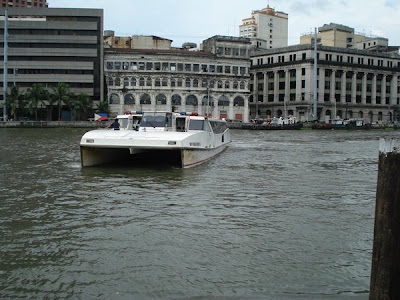

Being a boat with two hulls, swaying, panicky situations, and any discomfort are avoided. Comfort and safety are also guaranteed in every trip. Each built-in blue plastic seat has life-jackets under in case of emergency. The crews are always on standby and are equipped with radios being used to contact the Philippine coast guard in case things go awry.

The air conditioned boats are also installed with entertainment systems. Some have a flat screen television while others have quality sound systems. Placed behind the cabin is an empty bar which serves as a hangout for the crew. It also has a dock area where the commuter can go out and enjoy the view of diving seagulls, industrial structures, and people who waves at you from the riverbanks.

The seats are divided in to three columns, two 3-seater columns on both sides and a 4-seater column in the middle. The wide fiber glassed windows reach the top edge of the boat making passengers enjoy the view of the river.
The stations
The Pasig Ferry Service has 14 stations from Plaza Mexico in Intramuros, Manila to Kalawaan, Pasig. The bar code based ticketing system was used during the first few months of its operation but was replaced by the traditional paper tickets today. Ticket prices vary, from kalawaan to Sta. Ana station, ticket costs 25.00Php, from there to PUP Manila station, the price will have a 10 peso increase, another 10 will be added to the fare from there to Escolta. Students are discounted and should only pay 20 pesos in any stations they prefer to disembark.

Safety
Safety is a primary concern, especially to first time commuters. The Philippine coast guard headquarters is located just past the PUP station. One radio message sent to one those means one quick response. To add to the security, each boat is accompanied by an armed Presidential Security Group marshal. Since the Ferry passes by the Malacanang Palace, the very seat of our Government, this became a protocol.


Huge barges, tankers, and small boats are being met along the way. The Ferry then keeps a slightly narrow distance and then slows down every time this situation occurs especially under bridges.

During the rainy season, the service is still operational even in storm signal number 1. Since the Ferries are on a river and does not produce huge waves, it is still okay to operate. The Ferry will only stop transporting passengers when storm signal number 2 hits the Metro.
The crews are equipped with hand and rocket flares which are needed especially during the 7pm trip. Lifebuoys are also found on the river to set the person afloat.

Rules and regulations are also implemented by the management. Smoking, bringing of alcoholic beverages and possession of deadly weapons are strictly prohibited. Also, taking photographs of the palace is strictly prohibited. The crew also asks the people nicely to go inside the boat every time the water bus passes by Malacanang. They prohibit going out until it reaches past PUP station.
Welcome aboard
The first challenge encountered by the PRRC and the NTSI is how to convince people of not only its safety but also its sanitation. They anticipated the people’s impression that the river emits a stench that an ordinary person cannot stand, not to mention holding a passenger’s breath for an hour.
The strategy made was to promote the river using their media partner, GMA-7 network INC. Soon afterwards, feature stories and documentaries regarding the Ferry Services suddenly sprouted in the tube for the people’s information.
 |
| Makati-Mandaluyong border along Guadalupe |
Other government organizations helped out to make this possible. The Department of Environment and Natural Resources and the Metro Manila Development Authority held a project to clean up the garbage in the river. MMDA provided tractors and machinery for the cleanup. DENR on the other hand, adopted measures to revive the river under their River Basin Management and Development Master Plan. Because of the projects, the river is now odor free even if the passenger stays on the dock area.

Some barges, tankers, and other huge industrial water cargos already sank in the past due to the heavy density of pollution of the river. As of now, there are no records of Ferry accidents since its reopening in 2007, assuring safety to the passengers. This is according to Allan Mendoza, officer in charge of the Guadalupe Station.
The earlier projects
We aren't the first generation to enjoy the benefits of the Pasig ferry Service. During the 90’s, two ferry boat services were launched but only operated in a short period of time.
The first operation started in 1990 called the Magsaysay Lines. The stations were simpler back then, only using sheds for the waiting commuters. The station was shorter, starting from Escolta to Guadalupe. Unfortunately, Magsaysay Lines halted its trips in 1991 due to the excessive garbage and water lilies that obstructs the boat’s propellers thus adding problems to the boat and hassle to the passengers.
 |
| The Manila Post Office as viewed from the ferry deck |
It was then followed by the Starcraft Ferry Service that was launched in 1996. It used 11 dual hulled catamaran boats, a lot compared to the four being used today. The services were longer than the first one, ferrying people from Escolta to Bambang, Pasig. Similar to the structure, the only difference is that the ancestor boats of the current ferry service were only a 30-seater. Like the Magsaysay lines, the same problems were met thus terminating the operation.
 |
| Locals along the riverbanks |
Next stop
Future plans are already on the go for PRRC. Guadalupe station OIC Allan Mendoza said that by October, the newly built Marikina Station will be operational. They also plan to put up station as far as Libis, Taguig, and Laguna. Another is the purchase of more boats by the NTSI.
The Pasig River Ferry Service is indeed a very economical and at the same time, safe transportation for everyday commuters. With its tight security, responsive crews, rules, and safety equipments, passengers indeed have an enjoyable and sound cruise towards the 27-Kilometer Pasig River regardless of the time and day.
________________________________________
*This article was printed last October of 2008 as a final requirement for my News and Feature Writing class.
*Photos were taken using a Nikon FM film camera loaded with Fuji Sensia 200 slide film cross-processed, and a Sony Cybershot DSC-W70


1 comment:
Gevin suffers from Asperger's syndrome, a form video game stores of MR. Tales of Xillia Tales of Xillia Tales of Xillia is the thirteenth entry in the long-running Tales series of role playing games. The game is available to them due to disabilities of one kind or another. Nintendo a company that generally caters to a family-friendly crowd fares only slightly better with games for the holiday shopping season.
my page ... christian video games
Post a Comment